
Why are Costa Rica expat properties shifting toward highland estates?
In our years on this coast, we have watched the demand for costa rica expat properties undergo a structural shift. North American buyers are increasingly moving away from high-heat coastal corridors in favor of expansive highland estates. Buyers from the US and Canada are prioritizing multi-structure, high-acreage properties that offer cooler climates, self-sufficiency, and multi-generational living configurations. This shift is driven by a desire for larger land parcels where buyers can secure privacy and build additional structures without paying the premium prices associated with beachfront zones like Jacó or Manuel Antonio.
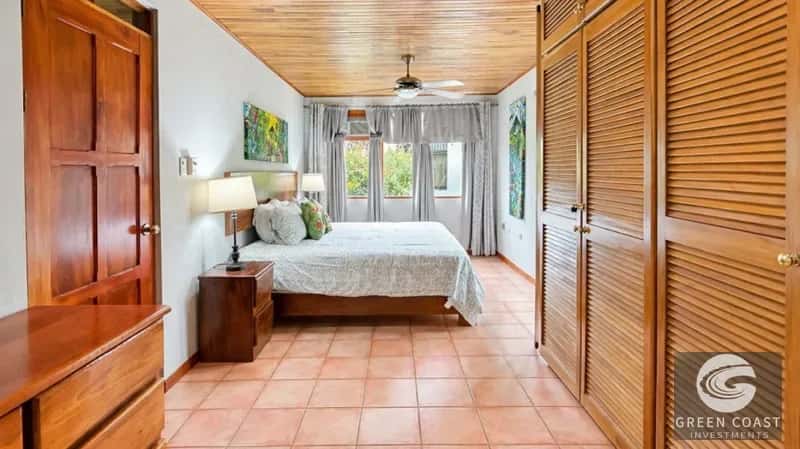
A prime example of this shifting market dynamic is the featured 6-Bed Lake Arenal Estate with Pool, Guest Casitas & Expansion Lot. Priced at USD 435,000, this property features a spacious main house, independent guest casitas, a private swimming pool, and an adjacent expansion lot. For expats, this specific configuration represents a balance of immediate privacy, built-in rental income potential, and long-term value appreciation. By securing a multi-structure estate in the highlands, buyers acquire a versatile compound that can function as a private family estate, a co-living space, or an active income-generating micro-resort—all at a fraction of the cost of coastal alternatives.
Analyzing the Highland Value Proposition
To understand why highland estates are capturing the attention of investors, it is helpful to look at the broader regional inventory. Across the Lake Arenal market, there are currently 82 active listings. These properties span a price range from USD 40,000 for raw land parcels up to USD 3,800,000 for massive commercial estates, with a market average of USD 576,749.
| Market Metric | Lake Arenal Regional Value | Featured Estate Value |
| :--- | :--- | :--- |
| Active Listings | 82 | 1 (Featured Property) |
| Price Range | USD 40,000 – USD 3,800,000 | USD 435,000 |
| Average Price | USD 576,749 | USD 435,000 (24.5% below average) |
At USD 435,000, the 6-bed Lake Arenal estate sits well below the regional average of USD 576,749, despite offering a fully developed multi-structure footprint and an extra buildable lot. This price-to-value ratio is increasingly rare in Costa Rica's real estate market.
Microclimates and Cost of Living Advantages
Beyond the real estate metrics, the physical geography of the highlands offers distinct financial advantages that appeal to long-term expats.
At elevations surrounding Lake Arenal, natural mountain breezes replace the need for 24/7 air conditioning, lowering monthly electricity bills compared to coastal properties. The rich volcanic soil and consistent rainfall allow expats to establish organic gardens and orchards, supporting a self-sufficient lifestyle. Furthermore, unlike cramped gated communities on the coast, highland estates provide the physical space required to build additional workshops, yoga decks, or rental units as needs evolve.
---
Is Lake Arenal considered part of the Central Valley for real estate buyers?

No, Lake Arenal is not considered part of the Central Valley. Geographically and culturally, Lake Arenal belongs to the Northern Highlands of Costa Rica, separated from the Central Valley by the Cordillera Central mountain range. While both regions attract buyers searching for premier costa rica expat properties outside of the humid coastal zones, they offer distinct lifestyles, climates, and investment dynamics.
The Geographic and Climatic Divide
International buyers often confuse these two highland regions because both feature cooler temperatures than the Pacific coast. However, the traditional Central Valley—encompassing San José, Escazú, Santa Ana, and Atenas—is an urbanized plateau. In contrast, the Lake Arenal region is characterized by rolling hills, primary rainforests, and the country's largest landlocked body of water.
The microclimates of these two regions differ significantly:
Wind Patterns:* Lake Arenal experiences strong, consistent trade winds from November to April, making it a windsurfing destination. The Central Valley receives moderate breezes but lacks this sustained wind energy.
Rainfall:* Lake Arenal receives substantially more rainfall than the Central Valley, particularly during the green season. This precipitation keeps the Arenal landscape green year-round, whereas parts of the Central Valley can become dry and brown during the summer months.
Temperature Variations:* Lake Arenal maintains steady daytime temperatures between 70°F and 85°F. The Central Valley, depending on the altitude of specific suburbs, can experience wider temperature swings and stronger midday heat.
The Highland Transition Zone Advantage
For expats, the transition zone between the Central Valley and the Northern Highlands represents a sweet spot in Costa Rica real estate. By moving slightly north of the valley toward Arenal, buyers escape the urban congestion, traffic, and higher air pollution of the metropolitan area.
This transition zone provides a temperate climate that avoids the intense heat of coastal beach towns like Jacó, yet it retains a lush, vibrant ecosystem. You do not need air conditioning here, which reduces monthly utility bills—a major selling point for long-term expat residents and retirees.
Lake Arenal Market Data
The real estate market around Lake Arenal remains active, offering diverse opportunities for buyers seeking space and privacy. Currently, there are 82 active listings in the region, with prices ranging from USD 40,000 for raw land parcels to USD 3,800,000 for luxury lakefront estates. The average listing price in this market stands at USD 576,749, reflecting the growing demand for high-quality highland properties.
How does this $435k estate compare to Central Valley Costa Rica real estate trends?
This $435,000 Lake Arenal estate offers a lower entry price and superior value-per-square-meter compared to the average Central Valley property. While the Central Valley remains a primary hub for buyers searching for Costa Rica expat properties, current MLS data reveals that a multi-structure estate of this caliber at this price point is virtually non-existent in the metropolitan highlands. Acquiring a six-bedroom compound with active rental income and an additional development lot for under $450,000 represents a market anomaly when contrasted with the inventory of the San José and Alajuela suburbs.
Central Valley MLS Data vs. Lake Arenal Value
To understand the financial advantages of this estate, look at the active inventory in the Central Valley. A market analysis of the region reveals the following metrics:
Active listings:* 82
Price range:* USD 40,000 to USD 3,800,000
Average price:* USD 576,749
At USD 435,000, this Lake Arenal estate is priced 24.5% below the Central Valley average of USD 576,749. In the Central Valley, a budget of $435,000 typically secures a standard three-bedroom single-family home or a condominium within a gated community in Escazú or Santa Ana. These suburban properties rarely exceed 2,500 square feet of construction and sit on small, high-density lots with minimal privacy.
The Multi-Unit Premium and Expansion Potential
For expat investors, the financial divergence becomes clearer when evaluating the physical assets included in the sale. Finding a property in the Central Valley that features a main home, two independent guest casitas, a private pool, and a fully segregated, buildable expansion lot under the regional average price is nearly impossible.
In high-demand highland markets, land scarcity has driven up the cost of acreage. This Arenal estate provides the space and infrastructure of a commercial hospitality micro-project for the price of a suburban residential home. The inclusion of the expansion lot adds immediate equity, allowing buyers to build additional rental units or sell the parcel separately to recoup a portion of their initial capital investment.
---
What are the legal requirements for building on an additional expansion lot in Costa Rica?

Building on an expansion lot in the Lake Arenal region requires navigating specific zoning regulations, municipal approvals, and environmental validation before construction begins. While costa rica expat properties offer development potential, buyers must secure a municipal building permit (permiso de construcción), obtain a water availability letter (carta de agua), and verify land-use restrictions (uso de suelo) to legally expand. Across the country’s active inventory of 82 comparable highland and transition-zone listings—ranging in price from $40,000 to $3,800,000 with an average price of $576,749—the viability of raw expansion land depends entirely on these regulatory approvals.
Zoning Regulations and the Uso de Suelo
The first step in evaluating an expansion lot is requesting an Uso de Suelo (land-use certificate) from the local Municipalidad (municipality). This document dictates what percentage of the lot can be covered by structures (footprint coverage) and defines the setbacks required from property lines, public roads, and natural water sources.
In the Lake Arenal area, zoning is governed by local Planes Reguladores (regulatory plans) or national forestry laws if the property borders protected zones. Because Arenal is a high-rainfall area, municipal offices strictly enforce setbacks from natural runoff channels and protected forest borders. The Uso de Suelo will explicitly state if the expansion lot is classified as agricultural (which limits construction density to 15% or 25% depending on total size) or residential.
CFIA Registration and Municipal Permits
To obtain a building permit, you must work with a licensed Costa Rican architect or civil engineer registered with the Colegio Federado de Ingenieros y de Arquitectos (CFIA).
```
[Architect Designs Plans]
│
▼
[Digital Submission to CFIA APC System] ───► (CFIA calculates fees & reviews structural integrity)
│
▼
[Submission to Local Municipalidad] ───► (Buyer pays 1% municipal construction tax)
│
▼
[Building Permit Issued]
```
1. Blueprints and CFIA Submission: Your architect designs the expansion plans and submits them digitally to the CFIA APC system (Administración de Proyectos de Construcción). The CFIA calculates the mandatory minimum construction fees and reviews the structural integrity of the design.
2. Municipal Approval: Once the CFIA approves the plans, they are submitted to the local Municipalidad. You must pay a municipal construction tax, which is typically 1% of the estimated cost of the construction project.
Soil Tests and Water Availability in Highland Transition Zones
The geological profile of the Lake Arenal and Central Valley transition zones makes localized environmental testing mandatory.
Soil Stability Tests (Estudios de Suelo):* Due to the volcanic clay soils and high annual rainfall of the highlands, a professional soil stability test is required. This test determines the load-bearing capacity of the ground and dictates the depth and reinforcement level of the foundation to prevent shifting or erosion.
Water Availability Letters (Cartas de Agua): A building permit will not be issued without a certified carta de agua*. This official letter must come from the local ASADA (rural water board) or AyA (national water utility), confirming that the local water infrastructure has the capacity to service the new structure. In rural highland areas, securing this letter is a critical hurdle for development.
---
Can I generate rental income from guest casitas under Costa Rican tax laws?
Yes, you can legally generate rental income from guest casitas in Costa Rica, even as a non-resident. The country’s legal framework permits foreign owners of costa rica expat properties to operate short-term or long-term rentals, provided they register with the tax authority (Ministerio de Hacienda) and comply with local tax obligations. This multi-unit setup offers a way to offset holding costs or generate a steady yield while living in the main residence.
Rental Yield Potential in the Lake Arenal Market
Multi-unit properties featuring a main house and separate guest casitas are sought after by digital nomads, retirees, and eco-tourists. In the Lake Arenal region, where active listings currently total 82 properties—ranging in price from $40,000 to $3,800,000 with an average price of $576,749—this $435,000 estate sits below the market average while offering immediate income-generating infrastructure.
By renting out the guest casitas, owners can capitalize on the demand for wellness tourism and remote-work hubs. A multi-unit estate allows you to live on-site while managing your rentals, which reduces operational overhead and maximizes your net yield compared to single-family homes.
Tax Obligations for Non-Resident Owners
Operating a rental property requires adherence to Costa Rican tax laws. To remain compliant, you must manage two primary tax categories:
Value Added Tax (IVA): Short-term rentals (leases under 30 days) are subject to a 13% Value Added Tax (Impuesto sobre el Valor Agregado*). You must collect this tax from guests and file monthly returns with Hacienda.
Income Tax (Impuesto sobre the Renta):* You must declare your rental income annually. Non-residents typically file under a simplified regime or pay a flat withholding tax on gross rental income, depending on how the property is structured. Deductions for maintenance, depreciation, and local management expenses can be applied under the traditional corporate tax filing system to lower your taxable net income.
Property Management and Logistics in Lake Arenal
Managing a rental property in the Lake Arenal highlands requires reliable local support, especially if you travel frequently. Because the region is characterized by humid microclimates, continuous property maintenance is essential.
Hiring a local caretaker (administrador) or a regional property management agency is an effective way to handle check-ins, cleaning, and emergency repairs. For remote bookings, most expats utilize platforms like Airbnb and VRBO integrated with channel managers. This setup allows you to automate guest communication and payment processing while your on-ground staff manages the physical upkeep of the pool, gardens, and casitas.
---
What are the annual holding costs, including luxury taxes, for a multi-structure estate?
The annual holding costs for a multi-structure estate in Costa Rica are low compared to North American standards, typically averaging between 1% and 1.5% of the property's value per year. For a multi-dwelling estate, these costs primarily consist of the municipal property tax (Impuesto Territorial) set at a flat rate of 0.25% of the registered property value, the luxury home tax (Impuesto Solidario) if applicable, corporate maintenance fees, and local utility costs.
Municipal Property Tax and the Luxury Tax Threshold
The foundational holding cost is the municipal property tax, calculated at 0.25% of the property value registered with the local municipality. For example, on a property valued at $435,000, the annual municipal tax is just $1,087.50.
For high-value costa rica expat properties featuring multiple structures like guest casitas, buyers must also evaluate the luxury home tax (Impuesto Solidario). This progressive tax applies only to residential properties where the construction value alone exceeds an annually adjusted threshold (approximately $250,000 to $270,000 USD).
Construction Valuation:* If the combined construction value of the main villa, guest casitas, and pool exceeds the threshold, the tax is applied on a sliding scale from 0.25% to 0.55% on the combined value of both the construction and the land.
Exemptions:* If the individual structures are modest and the primary villa's construction value falls below the threshold, the estate may be exempt from this tax entirely, even if the total market value is high.
Corporate Maintenance and HOA Fees
Many buyers purchase estates through a Costa Rican corporation (Sociedad Anónima or Limitada). Maintaining this structure incurs specific annual fees:
Corporate Tax (Impuesto a las Personas Jurídicas):* Approximately $120 to $300 USD annually, depending on whether the corporation is active or inactive.
Resident Agent Fee:* Around $300 USD annually for a local attorney to represent the corporation.
Shareholder Declaration (Registro de Transparencia y Beneficiarios Finales):* An annual filing fee of $100 to $200 USD for legal assistance.
Highland Utility Averages
Because Lake Arenal sits in the highland region, the temperate climate eliminates the need for 24/7 air conditioning, which is a major cost driver in coastal towns like Jacó. Average monthly utilities for a multi-structure estate in this region generally range from $150 to $300 USD, covering high-speed fiber-optic internet, water, and electricity.
This low-overhead environment is competitive. Currently, there are 82 active listings in the Lake Arenal area, with prices ranging from USD 40,000 to USD 3,800,000, and an average market price of USD 576,749. This makes well-priced, multi-structure estates efficient vehicles for wealth preservation and rental yields.
---
How do I navigate corporate ownership structures (S.A.) for high-value estates?
Purchasing Costa Rica expat properties through a Costa Rican corporation—specifically a Sociedad Anónima (S.A.) or a Sociedad de Responsabilidad Limitada (S.R.L.)—is the standard method for securing high-value real estate assets. This legal structure shields your personal assets from liability, simplifies future estate planning, and allows for the streamlined transfer of utility contracts and local permits. Rather than holding the deed in your personal name, the property is registered under the corporation, and you hold the shares of that entity.
Choosing Between an S.A. and an S.R.L.
When acquiring a multi-structure estate, you must choose the corporate structure that aligns with your management style. An S.A. is a traditional corporation requiring a board of directors (president, secretary, and treasurer) plus a resident agent. It is ideal for properties with multiple unrelated investors. An S.R.L. is a limited liability company that requires only one manager and has simpler transfer restrictions, making it popular for individual expats or family trusts.
Annual Compliance and Corporate Obligations
Holding a Costa Rican corporation requires adherence to annual administrative duties to keep the entity in good standing. Failure to meet these requirements can result in freezes on your property registry filing or financial penalties.
Corporate Tax (Impuesto a las Personas Jurídicas):* An annual tax due every January, calculated based on whether the corporation is active or inactive.
Shareholder Registry (Registro de Transparencia y Beneficiarios Finales):* An annual declaration filed every April with the Central Bank of Costa Rica, disclosing the ultimate beneficial owners of the corporate shares.
Resident Agent Fees:* If the corporate officers do not reside in Costa Rica, a local attorney must be appointed as the resident agent to receive legal notifications.
Income Tax Declaration (Form D-101 or D-140):* Inactive corporations holding only asset-level real estate must still file an annual balance sheet declaration to report assets, liabilities, and equity.
How Green Coast Investments Secures Your Transaction
The Lake Arenal and surrounding highland markets currently feature 82 active listings ranging from USD 40,000 to USD 3,800,000, with an average price of USD 576,749. Navigating transactions in this price bracket requires experienced oversight.
Our team at Green Coast Investments protects your capital through a structured cross-border transaction process:
1. Due Diligence Coordination: We coordinate with trusted bilingual notary publics to run title searches in the National Registry (Registro Nacional), checking for annotations, liens, or municipal tax debts.
2. Escrow Setup: We facilitate the establishment of secure, SUGEF-regulated escrow accounts to hold your earnest money deposit and final purchase funds safely.
3. Corporate Formation or Transfer: Our legal partners draft the incorporation documents for your new S.R.L. or S.A., or perform a comprehensive audit if you are purchasing an existing corporate entity that holds the property deed.
4. Closing and Registration: We oversee the execution of the transfer deed (escritura) and ensure the prompt registration of your corporate ownership in the public records.
---
Frequently Asked Questions About Buying Expat Properties in Costa Rica
Foreign buyers can legally own fee-simple real estate in Costa Rica with the same constitutional rights as Costa Rican citizens. There are no citizenship or residency requirements to purchase, hold, or sell property in the country. This equal protection under the law is a primary reason why Costa Rica expat properties remain sought after by North American buyers.
Can US and Canadian citizens legally own fee-simple property in Costa Rica?
Yes, US and Canadian citizens enjoy full fee-simple ownership rights. Unlike some Latin American nations where foreigners are restricted to leaseholds or must use bank trusts near borders and coasts, Costa Rica grants foreigners direct title ownership. This means your name or your corporation's name is registered directly in the Registro Nacional (National Registry). The only exception applies to Concession Land within the Maritime Zone (the first 200 meters of the high tide line), which carries specific ownership restrictions for non-citizens.
What are the closing costs for a USD 435,000 property purchase?
Closing costs in Costa Rica generally total between 3.5% and 4% of the property's declared value. For a USD 435,000 estate, you should budget approximately USD 15,225 to USD 17,400 to cover these transaction fees.
The breakdown of these expenses typically includes:
Real Estate Transfer Tax:* 1.5% of the purchase price.
National Registry Fees & Documentary Stamps:* Approximately 0.8% of the transaction value.
Notary/Attorney Fees: Legally set by a sliding scale (Arancel*) established by the Costa Rican Bar Association, averaging around 1% to 1.25% plus 13% VAT on the legal services.
These costs are traditionally split 50/50 between the buyer and the seller, though the exact division can be negotiated during the offer stage.
How does the residency process work for real estate investors?
Purchasing real estate in Costa Rica provides a direct path to legal residency under the Inversionista (Investor) category. The current residency investment threshold is USD 150,000. Because the purchase price of this USD 435,000 Lake Arenal estate comfortably exceeds this minimum, the investment qualifies you, your spouse, and dependent children under 25 for temporary residency.
To apply, you must submit registered deed documents proving the investment value, along with apostilled background checks, birth certificates, and marriage certificates from your home country.
What does the current market look like for Lake Arenal expat properties?
The Lake Arenal real estate market remains active, offering diverse options for foreign buyers. Currently, there are 82 active listings in the region. Prices range from USD 40,000 for raw land parcels to USD 3,800,000 for premium lakefront estates, with an overall average listing price of USD 576,749. This places a multi-structure, USD 435,000 estate with guest casitas well below the regional average, presenting a strong value proposition.