
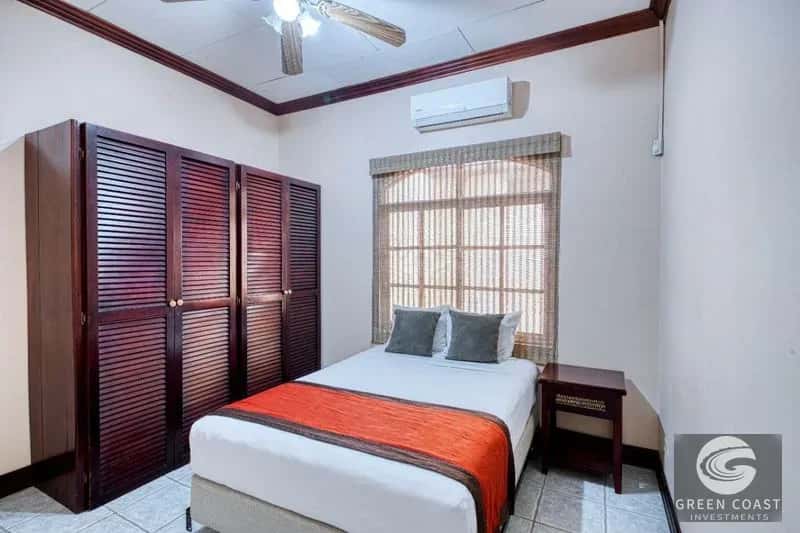
Looking to buy property jaco costa rica with immediate revenue potential? This USD 989,000 multi-family asset is a fully operational, private 6-villa vacation rental complex located minutes from the Los Sueños Marina and Golf Resort. Offering multi-key flexibility, a central swimming pool, and low operational overhead under a single title, it provides North American real estate investors a high-yield entry point into the Central Pacific hospitality market.
In our two decades on this coast, we have seen demand shift steadily toward compounds that accommodate multi-generational families and sportfishing groups. Positioned in the Garabito municipality, this private compound captures booking demand from luxury sportfishing groups, eco-tourists, and long-term remote workers. By combining commercial-grade cash flow with fee-simple property rights, it stands out as a practical alternative to single-unit condo investments.
Buy Property Jaco Costa Rica: 6-Villa Complex Overview
Investors who buy property in Jacó choose multi-family assets over traditional single-unit condos because multi-family compounds diversify cash flow across several rental streams, yield higher occupancy rates, and remove the operational restrictions imposed by high-rise homeowner associations. Purchasing a multi-unit complex allows owners to target distinct tourist segments simultaneously—such as luxury sportfishing groups, eco-travelers, and long-term remote workers—maximizing gross rental revenue while controlling maintenance and management costs under a single title.
Multi-Family Asset Strategy Near Los Sueños Marina
Priced at USD 989,000, this 6-Villa Vacation Rental Complex with Pool Near Los Sueños Marina sits just down the road from the marina gates. The property features six independent villas, a central private swimming pool, landscaped grounds, and dedicated parking. By offering multi-key accommodations near a premier nautical hub, the asset captures booking demand from the sportfishing and yachting demographics that frequent the Central Pacific coast.
Rather than relying on the single-tenant occupancy model of an oceanfront condo, owning six distinct villas ensures baseline revenue even during regional seasonal shifts. Charter groups frequently seek private compounds that accommodate large parties while maintaining individual privacy—a niche that standardized high-rise developments do not satisfy.
Acquiring a multi-villa compound near Los Sueños allows North American investors to capture sportfishing tourism without the restrictive HOA covenants of single-unit high-rises.
Analyzing the Jacó Real Estate Inventory
The broader Jacó and Central Pacific property market offers a range of investment options, catering to small-scale buyers and institutional funds. Across the region, active listings currently sit at 490 properties, with market prices ranging from USD 24,009 for small unimproved parcels up to USD 337,000,000 for commercial resort holdings and development tracts. The average property price across all active inventory stands at USD 1,904,946.
At USD 989,000, an operational 6-villa complex sits well below the regional price average while delivering immediate commercial cash flow, making it a competitive entry point for investors seeking commercial-scale returns in Costa Rica's accessible coastal market.
Key Facts & Financial Breakdown for Multi-Unit Buyers

Acquiring a multi-villa asset near Los Sueños yields an average net capitalization rate between 8% and 11%, outperforming standalone condos in central Jacó that average 5% to 7% net returns. A 6-villa complex captures high-ticket demand from the Los Sueños Marina district while maintaining the lower operational overhead of the Garabito municipality. Across the broader market, active listings total 490 properties ranging from USD 24,009 to USD 337,000,000, with an average price of USD 1,904,946.
Rental Yields & Cap Rate Dynamics
Multi-unit properties near Los Sueños achieve consistent returns by mitigating vacancy risk through diversified unit types. While a single-family beachfront condo relies on a single booking stream, a 6-villa complex allows owners to target distinct segments—such as sportfishing charters, corporate retreats, and eco-tourists—simultaneously.
Gross vacation rental yields in the Jacó–Los Sueños corridor range from 12% to 15%. After accounting for variable expenses, property maintenance, utilities, and management, net cap rates settle higher than individual residential units.
Local Tax Liabilities: Municipal vs. Luxury Tax
Understanding fiscal obligations in Costa Rica is critical to maintaining accurate ROI projections. Property taxes in the municipality of Garabito fall under two primary categories:
Standard Municipal Property Tax (Impuesto Territorial): Fixed at a baseline rate of 0.25% per year, calculated against the registered fiscal value of the property with the local Dirección General de Tributación*.
Luxury Home Tax (Impuesto a las Casas de Lujo):* Applies exclusively to residential structures where the physical construction value exceeds the primary threshold of approximately USD 235,000 (adjusted annually).
Multi-unit complexes often optimize this tax structure. Because the luxury tax applies to individual residential structures rather than the underlying commercial land value, individual small-footprint villas frequently fall below the construction value threshold, exempting the owner from the additional progressive tax rate (0.25% to 0.55%).
Operational Cost Structure: Self-Managed HOA vs. Third-Party Management
Managing operational overhead determines whether a property hits the upper boundary of yield projections. Investors in Garabito generally select between two operational models:
| Expense Model | Typical Cost | Operational Impact |
| :--- | :--- | :--- |
| Third-Party Management | 20% – 30% Gross Revenue | Fully hands-off management, full guest servicing |
| Self-Managed / On-Site | 8% – 12% Gross Revenue | Direct administrative oversight, higher net yield |
Third-party management firms in Jacó handle marketing, guest check-ins, maintenance, and municipal compliance, charging between 20% and 30% of gross rental revenue. Conversely, structuring the 6-villa complex with dedicated on-site staff cuts overhead down to 8% to 12%. This operational efficiency directly increases net operating income (NOI) by 150 to 300 basis points annually.
Why is a multi-villa complex near Los Sueños higher-yielding than a Jaco beachfront condo?
A multi-villa complex near Los Sueños generates higher yields than a Jacó beachfront condo by driving rental revenue through multiple income streams, capturing high-spending sportfishing tourism, and maintaining lower operational risk. While a single oceanfront condo relies on 100% occupancy of one unit to generate return, a 6-villa compound allows owners to host multiple groups simultaneously or capture large multi-generational travel, driving higher net cash flow per square meter.
Cash-Flow Dynamics: Single-Unit Condos vs. Multi-Villa Compounds
Comparing a traditional beach condo to a multi-unit investment reveals stark differences in revenue efficiency. Single-unit oceanfront condos in Jacó face high HOA fees and competitive rental markets. In contrast, a 6-villa compound operates under one property title, consolidating utility overhead, property taxes, and management expenses while scaling gross rental returns across six doors.
The regional market reflects this revenue capacity. Across the broader Garabito municipality, active listings total 490 properties, spanning a price range of USD 24,009 to USD 337,000,000, with an average price of USD 1,904,946. A multi-villa property positioned in this high-demand corridor capitalizes on this valuation tier by functioning as a boutique hospitality operation rather than a single residential unit.
Capturing the High-Yield Los Sueños Sportfishing Market
Positioning a complex near the Los Sueños Resort and Marina provides direct exposure to sportfishing tournaments and luxury travel segments. Anglers, yacht charters, and international travel groups visiting Marina Los Sueños prefer private residential compounds over standard residential towers. Groups associated with sportfishing events pay higher nightly rates for private compounds that accommodate full crews and families.
According to data from the Garabito Chamber of Tourism, properties within the Los Sueños corridor maintain average high-season occupancy rates of 68% to 74%. Furthermore, anglers and luxury vacationers frequently book week-long stays, outperforming the short two-night average stay typical of central Jacó oceanfront condo rentals.
Asset Diversification and Risk Mitigation Under One Title
Investing in a 6-villa complex mitigates vacancy risk through structural diversification. If a single beachfront condo sits vacant, property revenue drops to zero for that period while HOA and maintenance costs continue. With six income-generating units under a single title, vacancy in one or two units is absorbed by the cash flow of the remaining operational villas. This structure protects baseline yield during seasonal shifts while offering the flexibility to convert individual units into long-term leases, owner quarters, or dedicated private event spaces.
What Buyers Ask About Legalities and Operating Businesses

Foreign investors can acquire property in Jacó with the same fee-simple ownership rights as Costa Rican nationals. Under Article 45 of the Costa Rican Constitution, property rights are protected regardless of nationality, allowing US and Canadian buyers to own real estate outright without requiring a local partner or residency status. For a multi-unit commercial operation like a 6-villa complex, foreign buyers secure these rights by purchasing titled property outright or acquiring an existing corporate entity that holds the real estate title and municipal operating licenses.
Corporate Structuring for Multi-Unit Acquisitions
When acquiring commercial residential real estate in Jacó, holding the asset through a Costa Rican legal entity is standard practice. Investors typically structure acquisitions using either a Sociedad Anónima (S.A.) or a Sociedad de Responsabilidad Limitada (S.R.L., similar to a US LLC).
Holding a multi-villa enterprise inside an S.A. or S.R.L. insulates personal foreign assets from local operational risks, guest claims, or staff labor obligations. A local corporate entity facilitates local bank account setup, asset management, utility transfers, and direct employment of site managers or maintenance staff under Costa Rican labor law. Additionally, acquiring a property by purchasing 100% of the shares of an existing holding corporation can preserve existing commercial permits, tax registrations, and operating history.
Navigating Local Market Valuations and Entity Taxes
The broader regional market reflects a wide range of investment entry points for commercial and residential inventory. Across the area, active listings total 490 properties, with prices ranging from USD 24,009 to USD 337,000,000, and an average price of USD 1,904,946. Multi-villa assets sit in a distinct asset class within this spectrum, blending residential flexibility with commercial revenue generation.
Corporate entity maintenance requires budgeting for annual administrative costs:
Corporate Entity Tax (Impuesto a las Personas Jurídicas):* A sliding-scale tax based on gross income reported to the tax authority. Inactive holding companies pay a lower baseline flat fee (approx. USD 120), while active revenue-generating companies pay an escalated rate depending on gross income tier (up to approx. USD 500+ annually).
Resident Agent Fees:* Foreign investors without local residency must appoint a Costa Rican attorney as an official resident agent for legal notifications, costing between USD 300 and USD 600 annually.
Transparency and Beneficial Ownership Register (RTBF):* Costa Rica requires an annual electronic declaration disclosing ultimate beneficial owners of local corporate shares. Failure to file results in substantial municipal and national tax authority penalties.
Cross-Border Tax Reporting Obligations
Operating a revenue-generating real estate business in Jacó requires compliance with both Costa Rican taxation (Ministerio de Hacienda) and home-country tax authorities.
US citizens holding a foreign corporation (S.A. or S.R.L.) must comply with cross-border reporting laws, primarily submitting IRS Form 5471 (Information Return of U.S. Persons With Respect to Certain Foreign Corporations). Pass-through election options exist for S.R.L. entities using IRS Form 8832. Foreign financial accounts (such as local Costa Rican corporate bank accounts) exceeding USD 10,000 in aggregate at any time during the calendar year require filing FinCEN Form 114 (FBAR). Canadian tax residents must report specified foreign holdings exceeding CAD 100,000 via Form T1135, along with foreign affiliate reporting on Form T1134 if holding a controlling interest in a foreign corporation.
Partnering with bilingual legal counsel and a cross-border CPA ensures compliant corporate structuring, maintaining title protection under Costa Rican law while satisfying foreign income reporting rules.
How do municipal zoning laws (Plan Regulador) impact Jacó commercial properties?
Municipal zoning laws under the Garabito Municipality Plan Regulador dictate precise land-use parameters, density limits, and building footprints for mixed-use commercial and residential properties in Jacó. Investors aiming to buy property jaco costa rica for commercial rental operations must ensure the property's land-use certificate (Uso de Suelo) permits short-term hospitality and multi-unit residential operations. Operating a multi-villa asset without aligned municipal zoning risks operational suspension, fines, or denial of business permits.
Navigating Zoning and Land-Use Certificates
The Garabito Municipality enforces the Plan Regulador to control local development density and commercial activity. For a 6-villa complex, the Uso de Suelo document outlines allowable building coverage, structural height limits, and parking ratios. Commercial-residential properties must comply with these regulations to qualify for official utility connections and construction expansions.
Titled Land vs. Maritime Zone (ZMT) Concessions
Understanding property boundaries relative to the coastline is vital when evaluating Jacó and nearby coastal assets. Most inland residential and commercial parcels are fully titled (propiedad privada) in the National Registry (Registro Nacional). However, beachfront and near-shore parcels fall under Costa Rica’s Maritime Zone Law 6043 (Ley de Zona Marítimo Terrestre).
Under Law 6043, the first 50 meters from the high-tide line is strictly public land, meaning private ownership or commercial construction is prohibited within this strip. The adjacent 150 meters consists of concession land managed by the Garabito Municipality; properties in this zone are leased rather than owned outright, requiring municipal approval for transfers and commercial operations.
Essential Operating Permits and Municipal Licensures
Running a compliant multi-villa rental business requires specific state and municipal authorizations. First, you need a Health Permit (Permiso Sanitario de Funcionamiento) issued by the Ministry of Health (Ministerio de Salud), confirming the complex meets wastewater, electrical, and structural safety standards.
Second, the Garabito Municipality grants a Commercial License (Patente Municipal) upon presentation of a valid health permit and active land-use approval. Short-term rentals operating as commercial boutique hotels or multi-unit hospitality assets cannot legally collect rental revenue without this license in place.
Current Garabito Real Estate Market Landscape
Due to commercial zoning along primary corridors, Jacó remains an active market for multi-unit acquisitions. Across the Garabito canton, prospective investors can review active inventory where prices range from USD 24,009 for small unimproved parcels to USD 337,000,000 for development tracts, with an average price point of USD 1,904,946. Securing titled, multi-unit assets compliant with local municipal codes ensures income-generating property remains legally protected.
Regional Context: Jaco, Los Sueños, and Playa Hermosa Real Estate Market
The Central Pacific real estate market surrounding Jacó, Los Sueños, and Playa Hermosa represents an active property corridor for international investors. Across this micro-region, current inventory reflects 490 active listings spanning a price range from USD 24,009 to USD 337,000,000, with a regional average listing price of USD 1,904,946. Accessibility from Juan Santamaría International Airport (SJO via Highway 27) and year-round rental demand drive these valuations, particularly for multi-family assets positioned between downtown amenities and luxury resort infrastructure.
Infrastructure Analysis Across Key Micro-Markets
When clients ask our team to compare micro-markets across the Jacó, Los Sueños, and Playa Hermosa region, we break down the local infrastructure into three operating environments based on what we see on the ground every day:
1. Central Jacó (Urban Commercial Core)
Central Jacó serves as the primary commercial and economic center for the Garabito municipality. It features fully paved urban roads, high-speed fiber-optic internet infrastructure, commercial banking centers, private medical clinics, and comprehensive municipal trash and water collection services (AYA). High-density zoning along the main strip supports high-rise residential towers, commercial plazas, and short-term rental apartments. Because of its urban infrastructure, properties in central Jacó attract high tourist foot traffic but face greater noise pollution and higher HOA overhead in condominium buildings.
2. Herradura / Los Sueños Corridor (Luxury Nautical Resort Zone)
Located five minutes north of Jacó, the Herradura micro-market centers around the master-planned Los Sueños Resort and Marina. Infrastructure in this zone includes private water treatment facilities, gated access roads, underground electrical utilities, 24/7 private security patrols, and a full-service deep-water marina. Real estate valuations here sit in the upper tier of the regional market, driven by high-net-worth travelers, sportfishing charter operations, and golf enthusiasts. A multi-villa complex positioned just outside the resort gates capitalizes on Los Sueños amenity access without incurring internal resort master-association dues.
3. Playa Hermosa (Eco-Luxury & Surf Reserve Zone)
Located five minutes south of Jacó, Playa Hermosa is a World Surfing Reserve characterized by lower-density development and natural coastal preservation. Infrastructure includes paved highway access, reliable power grid connections, and expanding high-speed internet options, though municipal water distribution relies on a combination of local water boards (ASADAS) and private wells. Zoning under the Hermosa master plan strictly enforces lower building height limits to preserve the natural beachfront landscape. Properties here appeal to surf travelers, eco-tourists, and long-term expatriates seeking a quieter environment than central Jacó.
Real Estate Inventory Breakdown Across the Garabito Corridor
| Micro-Market Zone | Primary Asset Types | Market Driver | Infrastructure Strengths |
| :--- | :--- | :--- | :--- |
| Central Jacó | High-Rise Condos, Retail Plazas | High Nightly Occupancy, Nightlife | Fiber Internet, Municipal Services |
| Los Sueños Corridor | Luxury Villas, Marina Condos | Sportfishing, Luxury Resort Travelers | Private Security, Water Systems |
| Playa Hermosa | Eco-Lodges, Single-Family Homes | Surf Tourism, Low-Density Living | Natural Environment, Highway Access |
Across all three zones, active inventory stands at 490 listings, spanning from entry-level USD 24,009 land plots up to USD 337,000,000 commercial master developments. The regional average price of USD 1,904,946 highlights the concentration of luxury homes, commercial sites, and development tracts along Costa Rica's Central Pacific coast. Evaluating multi-unit properties within this broader context allows investors to select assets that offer realistic operational balance, legally sound title protection, and sustained cash flow performance.