
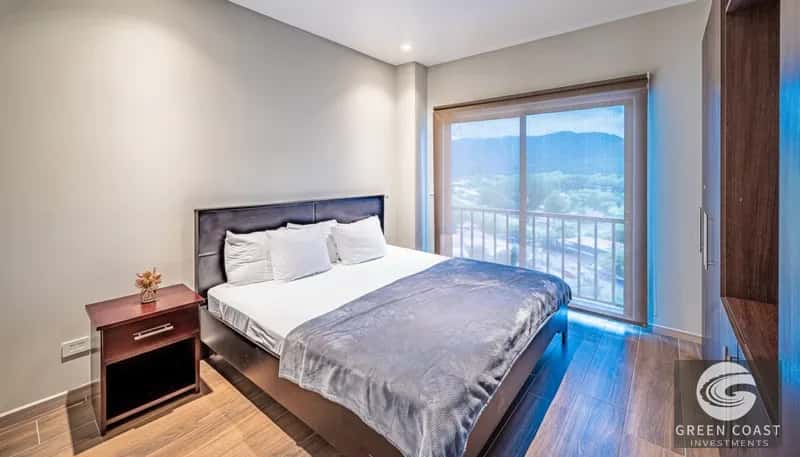
Looking to buy property in Jacó, Costa Rica? High-net-worth investors and buyers seeking high-performing real estate find premier opportunities in top-floor residences like the Jaco Bay Penthouse. With local property values ranging from accessible condos to multi-million dollar estates—and an overall average listing price around $1.9 million—Jacó offers exceptional rental yields and secure fee-simple ownership.
Positioned along the Central Pacific coast, Jacó combines modern infrastructure, high-speed fiber-optic connectivity, and close proximity to San José with an active vacation rental market. Buyers looking to explore the regional market for lifestyle residency or build a diversified international portfolio target top-tier inventory along this stretch of coast for long-term capital appreciation.
Overview
In our years on this coast, we have watched Jacó evolve into one of the most liquid real estate markets in Central America. For buyers planning to buy property in Jacó, Costa Rica, top-floor residences represent a strong income-generating asset. This guide breaks down the specific financial metrics, legal mechanics, and operational realities of acquiring a premium residence in town.
Real Estate Market Snapshot
Understanding current inventory and valuation metrics is essential for establishing a smart bidding strategy along the Central Pacific corridor. The local market maintains a wide spread across property types:
Active listings:* 490 properties
Price range:* USD 24,009 – USD 337,000,000
Average listing price:* USD 1,904,946
| Market Metric | Current Data Value (USD) |
| :--- | :--- |
| Total Active Listings | 490 properties |
| Minimum Property Listing Price | $24,009 |
| Maximum Property Listing Price | $337,000,000 |
| Average Listing Price | $1,904,946 |
While the broader regional average reflects large land parcels and multi-family development sites, luxury penthouses in established developments trade within a defined bracket that yields solid price-per-square-foot value compared to nearby resort enclaves like Los Sueños. You can view specific listings to evaluate how active inventory compares across the corridor.
Target Buyer Profiles
Acquiring a luxury penthouse in this region generally fits three core investment strategies. Income-focused buyers target USD-denominated rental revenue driven by Jacó's year-round tourism, international surf events, and proximity to San José.
Expat and lifestyle buyers seek a primary residence or semi-annual retreat offering modern infrastructure, fiber-optic internet, and walkability to services. Finally, portfolio diversifiers allocate capital into tangible real estate backed by Costa Rica's stable legal frame.
Market Context

Current market data shows that buyers looking to buy property in Jacó, Costa Rica will find 490 active listings across the greater Jacó region. Properties range from small entry-level condos at USD 24,009 to private estates priced up to USD 337,000,000, with an overall average listing price of USD 1,904,946. This spread accommodates individual condo buyers and large-scale developers alike.
```
Market Price Distribution (USD)
├─ Minimum Entry Tier: $24,009
├─ Regional Average: $1,904,946
└─ Maximum Listed Estate: $337,000,000
```
Current Inventory and Price Ranges
Inventory in Jacó spans several distinct real estate tiers. High-density oceanfront condominium developments drive a significant portion of local transaction volume. Penthouses and upper-floor units occupy the higher end of the residential condo market, commanding premium prices due to unobstructed Pacific views, space, and strong vacation rental demand. Multi-family assets like the 7-bedroom Jaco Bay Penthouse demonstrate how top-floor layouts maximize rental output for larger groups.
Single-family homes and private estates move inland toward the surrounding hillsides or stretch north toward private marina communities. While small studios and raw land skew the lower end of the statistical range, the core market for modern two- and three-bedroom luxury residences sits firmly in the mid-to-high six-figure range.
Local Property Comparisons
When we evaluate properties with clients on the ground, we compare Jacó against three main alternatives:
Oceanfront versus Hillside:* Direct beach access and high rental turnover in central Jacó towers versus the larger lot sizes, cooler breezes, and elevated privacy of hillside homes.
Central Jacó versus Los Sueños:* Central Jacó offers direct walkability, diverse dining, and lower HOA fees, whereas Los Sueños appeals to buyers looking for a gated marina, golf course, and master-planned resort environment.
Existing Inventory versus Pre-Construction:* High demand for modern finishes leads many investors to weigh move-in-ready condos against newly launched developments offering pre-construction pricing and phased payment schedules.
Structural Drivers of the Jacó Real Estate Economy
Jacó's real estate market operates under conditions distinct from other Central American coastal towns. Being the closest beach town to the capital city of San José gives it a unique advantage: high international vacation rental demand paired with reliable domestic weekend traffic.
Highway 27 upgrades have kept travel times from Juan Santamaría International Airport (SJO) under 90 minutes, allowing domestic buyers from the Central Valley to use second homes regularly and keeping property values stable during the international tourism low season. Furthermore, unlike more remote coastal markets in Guanacaste or the Southern Zone, Jacó runs on redundant fiber-optic lines and a stable municipal electrical grid while providing full-service supermarkets, banks, and medical clinics.
Buying Process

When you buy property in Jacó, Costa Rica, you enjoy the same legal protections as local citizens, holding full fee-simple ownership rights for titled land outside the maritime zone. Most transactions take 30 to 60 days to close. Buyer closing costs average between 3.5% and 4.0% of the purchase price, covering notary fees, real estate transfer taxes, documentary stamps, and escrow administration fees through an official government registry.
Foreign Ownership Basics and Title Rights
Foreign investors acquire titled real estate directly in their individual names or through a Costa Rican corporation, typically a Sociedad Anónima or Sociedad de Responsabilidad Limitada. Holding property through a local entity simplifies long-term administration, tax filings, and local utility management.
Properties in the Jacó market fall under two legal frameworks: titled land and concession land. Titled properties provide absolute ownership registered in the Registro Nacional. Concession properties, located within the first 200 meters of the beachfront maritime zone, operate as a leasehold with the local municipality. To hold concession land directly, foreigners must reside in Costa Rica for at least five years or set up a local partnership structure.
Transaction Breakdown and Closing Fee Schedule
Closing expenses are set by Costa Rican law. Here is how standard transaction fees break down against the purchase price:
| Fee Category | Average Cost Percentage / Amount | Statutory Regulation / Notes |
| :--- | :--- | :--- |
| Real Estate Transfer Tax | 1.5% of declared purchase price | Paid to the Ministry of Finance (Hacienda) |
| Notary & Legal Execution Fee | 1.0% – 1.25% of purchase price | Regulated by Costa Rican Bar Association (Colegio de Abogados) |
| Documentary & Fiscal Stamps | ~0.8% of purchase price | Includes Judiciary, Municipal, Fiscal, and National Registry stamps |
| Escrow Service Fee | USD 600 – USD 1,000 (flat rate) | Handled by SUGEF-approved escrow entity |
| Total Estimated Closing Costs | 3.5% – 4.0% of purchase price | Typically split equally between buyer and seller |
Closing Timeline and Standard Transaction Phases
The acquisition path moves through three main phases:
Offer and Deposit (Days 1–10):* The buyer submits a formal offer. Once accepted, a 10% earnest money deposit goes into a SUGEF-regulated escrow account.
Due Diligence Period (Days 10–30):* The buyer's notary checks registry records, municipal tax statuses, HOA regulations, and boundary surveys.
Closing and Transfer (Days 30–60): Both parties sign the transfer deed (escritura*) before a notary public. Funds release from escrow, and the deed goes to the National Registry for recording.
```
Standard Real Estate Acquisition Timeline (30–60 Days)
├── Days 1–10: Offer Acceptance & 10% Escrow Funding (SUGEF Regulated)
├── Days 10–30: Due Diligence (Registry Search, HOA Audit, Survey Review)
└── Days 30–60: Closing Deed Execution (Escritura) & National Registry Filing
```
Corporate Ownership Structures and Tax Legalities
Foreign investors buying luxury condos often use a local corporate entity to hold title. Choosing the right structure protects personal liability and simplifies estate planning across jurisdictions.
Sociedad Anónima (S.A.) vs. Sociedad de Responsabilidad Limitada (S.R.L.)
Costa Rican law provides two primary corporate vehicles for real estate ownership:
1. Sociedad Anónima (S.A.): Requires a Board of Directors with at least three officers (President, Secretary, Treasurer) and a statutory auditor (Fiscal). Shares transfer via endorsement on physical share certificates and entry into the corporate share book.
2. Sociedad De Responsabilidad Limitada (S.R.L.): Functions like a North American LLC. Managed by one or more Managers (Gerentes), it eliminates the need for a full board of directors. Shares (cuotas) cannot be transferred to outside parties without giving first-right-of-refusal to existing holders.
```
Corporate Structure Comparison for Asset Holding
├── Sociedad Anónima (S.A.)
│ ├── Governance: Requires 3 Board Officers + 1 Auditor
│ └── Transferability: Share endorsements via private registry
└── Sociedad de Responsabilidad Limitada (S.R.L.)
├── Governance: Managed by single or multiple Gerentes
└── Transferability: Quotas subject to right of first refusal
```
Annual Corporate Compliance Obligations
Property owners holding real estate through Costa Rican corporations must maintain three main annual filings. First is the Corporation Tax (Impuesto a las Personas Jurídicas), an annual tax levied on corporations ranging from roughly $120 to $500 based on registered activity. Second, owners must complete the Transparency Register (RTBF), an annual electronic filing through the Central Bank portal disclosing ultimate beneficial owners holding 15% or more of corporate shares. Finally, entities pay the Education and Culture Tax, a small fee under $20.
Property Management and Short-Term Rental Financials
For buyers focused on yields, luxury residences in central Jacó perform as strong income-generating assets. Capitalizing on night rates requires steady operational management and clear tax compliance.
Operational Cost Components for Luxury Condos
To calculate net operating income (NOI) accurately, penthouse buyers must account for clear carrying costs:
```
Gross Rental Revenue Breakdown
├── Direct Expenses
│ ├── On-Site Management Fees (20% – 30% of gross revenue)
│ ├── HOA Dues (Building maintenance, security, insurance)
│ ├── Municipal Property Taxes (0.25% assessed value)
│ └── Luxury Home Tax (Applicable above construction thresholds)
└── Net Operating Income (NOI) Distribution
```
Tower complexes charge monthly HOA assessments covering 24/7 security, elevator maintenance, pool upkeep, insurance, and backup generators, with penthouses carrying higher monthly dues proportionate to their size. On-site management firms in Jacó charge between 20% and 30% of gross rental income to handle channel marketing, guest check-ins, cleaning, and maintenance. On the utility side, air conditioning is the largest variable expense for ocean-view units; installing high-efficiency inverter units protects your monthly returns.
Comprehensive Rental Tax Rules
Rental property operators must follow tax rules under the Ministry of Finance (Hacienda):
Value Added Tax (VAT / IVA):* A 13% tax levied on short-term vacation stays under 90 days, collected from guests and remitted monthly.
Capital Gains Tax:* A flat 15% tax applies to capital appreciation upon sale. For properties acquired before this law took effect, sellers can elect to pay 2.25% of the total sale price.
Income Tax on Rentals: Investors register under traditional income tax brackets or use a simplified regime for real estate rentals (Capitales Inmobiliarios*), which taxes rental income at an effective rate of 12.5% on gross revenue.
Common Questions
Buyers looking to buy property in Jacó, Costa Rica often ask about financing, property taxes, and residency pathways.
Financing and Taxes
Local mortgage financing in Costa Rica is costly and slow for non-residents. Most of our international buyers purchase using cash, home-equity lines from their home country, or seller financing programs.
Holding costs remain low compared to North American markets. Annual Property Tax (Impuesto Territorial) sits at a flat 0.25% of the property's registered value with the municipality. The Luxury Home Tax (Impuesto a las Casas de Agrado y Recreo) applies to residential properties exceeding a specific construction value threshold, scaling incrementally up to roughly 0.55%. For rental income, the effective rate is 12.5% on gross revenue under the simplified real estate tax structure.
Residency and Lifestyle Fit
Investing in property offers a clear path to legal residency under the Inversionista (Investor) category. The minimum real estate investment threshold sits at USD 150,000. Purchasing a residence in Jacó comfortably meets this requirement, covering the primary applicant and immediate dependents.
As the closest major beach community to San José and Juan Santamaría International Airport, Jacó functions equally well as an easy weekend getaway or a full-time base equipped with bilingual schools, private clinics, and high-speed infrastructure.