
Buying Property in Guanacaste: Complete 2026 Guide
When buyers look at the 2026 market for guanacaste real estate, they are usually weighing two distinct strategies: high-yield, high-density coastal beach towns, or private, climate-resilient inland retreats around Lake Arenal.
In our years on this coast, we have watched prime oceanfront corridors pull steady capital. Yet right now, high-end real estate in Guanacaste averages $1,457,000 for luxury holdings, with inventory spanning $1,300,000 to $1,674,000. At the same time, foreign buyers can secure direct fee-simple title and qualify for Costa Rican investor residency with a minimum real estate purchase of $150,000.
Some investors pursue short-term rental yields on the Pacific coast, while others evaluate the region around Lake Arenal for lower overhead and freshwater security. Either way, real success demands accounting for microclimates, water concessions, tax frameworks, and closing mechanics.
This guide breaks down the market data, regional operational differences, legal steps, and ongoing costs for acquiring premium property across Guanacaste in 2026.
---
Guanacaste Real Estate Overview: 2026 Market Summary
Buying guanacaste real estate in 2026 requires understanding the operational divide between coastal enclaves and inland lakefront estates. While oceanfront corridors continue to draw short-term capital, we are seeing a clear shift toward inland retreats around Lake Arenal. Buyers are targeting these micro-markets for larger lot footprints, lower utility overhead, and significantly higher spatial value per square meter. Matching your financial goals to national investment incentives while picking the right micro-market dictates your long-term returns.
```
+-----------------------------------------------------------------------+
| 2026 GUANACASTE LUXURY MARKET SUMMARY |
+------------------------------------+----------------------------------+
| Active Listings Analyzed | 3 Premier Estates |
| Minimum Price | USD 1,300,000 |
| Maximum Price | USD 1,674,000 |
| Average Listing Price | USD 1,457,000 |
| Investor Residency Threshold | USD 150,000 (Law 9986) |
| Primary Regional Transit Hub | Liberia Intl Airport (LIR) |
+------------------------------------+----------------------------------+
```
2026 Guanacaste Market Data Snapshot
High-end property metrics across the province reflect stable pricing and consistent demand from North American buyers. Premium inventory remains tight, maintaining firm price floors across primary regional hubs.
Active listings analyzed:* 3 premier Guanacaste estates
Price range:* $1,300,000 to $1,674,000
Average listing price:* $1,457,000
Data Source:* Green Coast Investments MLS Data (Q1 2026)
Investor Visa Pathways and Compliance Frameworks
Acquiring high-value property in Guanacaste opens a direct legal pathway to residency. Under Costa Rica Law 9986, foreign buyers purchasing real estate with a minimum investment of $150,000 qualify for the Inversionista (Investor) residency category. This threshold—reduced from the historical $200,000 requirement—applies to residential homes, raw land, or commercial parcels.
At Green Coast Investments, we structure every transaction around strict cross-border legal compliance. Due diligence means verifying clear title registrations at the Registro Nacional, confirming municipal tax standings, and setting up compliant escrow mechanisms under SUGEF (Costa Rica's financial regulatory authority) regulations. Structuring your acquisition properly ensures that your title transfer and residency petition move forward together without administrative stalls.
---
Microclimates, Infrastructure, and Taxes

Geographical variations across Guanacaste directly hit your wallet, daily operating costs, and long-term utility reliability. While coastal Guanacaste—including the Papagayo Peninsula, Tamarindo, and Playas del Coco—offers immediate Pacific Ocean access, highland Guanacaste around Lake Arenal presents a completely different microclimate and infrastructure profile. In the inland Arenal area, market data for executive listings shows active inventory priced between $1,300,000 and $1,674,000, averaging $1,457,000.
```
+------------------------------------------------------------------------------------+
| REGIONAL COMPARISON: COASTAL VS. HIGHLAND |
+--------------------------+--------------------------------+------------------------+
| FEATURE | COASTAL GUANACASTE | LAKE ARENAL HIGHLANDS |
+--------------------------+--------------------------------+------------------------+
| Climate Type | Tropical Dry Forest | Mountain Highland |
| Average Temperature | 85°F–95°F (29°C–35°C) | 75°F (24°C) |
| Cooling Needs | Constant Air Conditioning | Natural Lake Breezes |
| HVAC Energy Overhead | High (35% higher AC draw) | Low to None |
| Primary Water Source | ASADAs / Desalination / Wells | Spring-Fed Wells / Municipal|
| Vegetation Status | Arid/Brown (Dec–April) | Green Year-Round |
| Primary Investment Model | Short-Term Tourist Rentals | Eco-Wellness / Mid-Term|
+--------------------------+--------------------------------+------------------------+
```
Microclimate Realities: Coastal Dry Forest vs. Highland Breezes
The environmental contrast between coastal and highland Guanacaste dictates your architectural plans, building materials, and home maintenance budgets.
Coastal zones like Papagayo, Tamarindo, and Flamingo operate within a tropical dry forest climate. They endure prolonged dry seasons where ambient temperatures frequently top 90°F (32°C). Air conditioning systems run continuously, driving up mechanical wear and electrical utility bills. In fact, coastal air conditioning power draw averages 35% higher than highland Arenal estates based on ICE Costa Rica Power Grid Data. That variance compounds into a major difference in carrying costs over a five-to-ten-year holding period.
By contrast, the Lake Arenal basin sits at higher elevations with a year-round average temperature of 75°F (24°C). Freshwater breezes cool homes naturally, eliminating constant AC reliance and protecting finishes from salt-air corrosion. The coastal strip sees almost no rain from December through April, turning vegetation brown unless watered artificially. Lake Arenal receives consistent, year-round precipitation that keeps acreage green without complex irrigation.
Utility Infrastructure: Water Systems and High-Speed Connectivity
Verifying utility rights early in contract negotiations saves months of delay. Water access and telecommunications infrastructure vary widely depending on municipal boundaries.
Water Concessions and ASADAs
Coastal properties rely heavily on regional water boards known as ASADAs (Asociaciones Administradoras de los Sistemas de Acueductos y Alcantarillados) or private well concessions monitored by MINAE (Ministry of Environment and Energy). Securing a validated water availability certificate (carta de agua) is an absolute prerequisite for getting building permits or closing on land. In contrast, highland properties around Lake Arenal draw from high-capacity municipal lines or private, spring-fed wells with registered MINAE concessions, offering long-term water security.
Fiber-Optic Telecommunications
Fiber-optic internet now extends across Guanacaste's primary corridors. Major telecom operators deliver direct gigabit fiber lines into gated communities throughout Papagayo, Tamarindo, and the main access routes around Lake Arenal. For properties located farther down rural roads, we routinely assist buyers in installing Starlink satellite hardware as a primary connection or automated backup.
---
Lake Arenal vs. Beach Towns: Location and Income Models

Selecting a property location in Guanacaste comes down to balancing your rental strategy against local density and climate. Coastal hubs like Tamarindo, Playas del Coco, and Las Catalinas deliver high tourist foot traffic and surf access, but they also bring seasonal dryness, heavy holiday congestion, and high utility bills. The Lake Arenal region offers quiet privacy, temperate weather, and lower long-term operating costs.
Lifestyle Factors: Vegetation, Climate, and Density
Daily life splits sharply between these two Guanacaste micro-markets. On the Pacific coast, you get dense commercial strips, active foot traffic, direct beach access, and international dining. The tradeoff comes in dry-season crowds, traffic bottlenecks on secondary roads, and seasonal municipal water rationing.
Inland around Lake Arenal, life centers on open space, privacy, and green surroundings that stay lush all twelve months. The elevation keeps temps right near 75°F (24°C), so you live comfortably outdoors without running air conditioning.
Rental Income Models: Short-Term Yields vs. Eco-Wellness Stability
Coastal homes earn peak short-term vacation rental returns during the winter months from December through April. However, they require hands-on property management, incur higher repair bills from salt air, and face noticeable occupancy drops in the rainy season.
Lake Arenal properties pull income from long-term leases, wellness retreats, eco-luxury rentals, and remote executives working under Costa Rica's Digital Nomad Law. Lower maintenance requirements and steady occupancy generate predictable cash flow.
Buyers reviewing premium inland options in the Arenal sector face a tight market. You can view active luxury listings to study current sector metrics:
Active listings:* 3
Price range:* $1,300,000–$1,674,000
Average price:* $1,457,000
Market Shifts in 2026
In our field observations across this market, North American buyers in 2026 are increasingly looking past dense beach markets. They are choosing to secure freshwater access, broader acreage, and up to 40% more interior square footage per dollar by shifting inland toward Lake Arenal.
While beach towns fit buyers focused strictly on short-term vacation rentals and active nightlife, Lake Arenal attracts investors prioritizing capital preservation, freshwater resources, and private luxury living.
---
Transit Logistics: Liberia International Airport Proximity
Door-to-door transit time from Daniel Oduber Quirós International Airport (LIR) in Liberia dictates practical convenience for homeownership and rental management. LIR is northwestern Costa Rica's primary international entry point, handling over 1.6 million international passengers annually according to the Costa Rica Tourism Board (ICT).
```
+------------------------------------------------------------------------------------+
| TRANSIT TIME FROM LIBERIA AIRPORT (LIR) |
+---------------------------+-------------------+----------------+-------------------+
| REGION / DESTINATION | DISTANCE FROM LIR | TRANSIT TIME | PRIMARY ROUTE |
+---------------------------+-------------------+----------------+-------------------+
| Papagayo Peninsula | 35 km (22 mi) | 35–45 mins | Route 21 / 253 |
| Playas del Coco | 25 km (15 mi) | 30 mins | Route 151 |
| Tamarindo | 67 km (42 mi) | 75–90 mins | Route 21 / 155 |
| Lake Arenal (Peninsula) | 95 km (59 mi) | 90–120 mins | Route 1 / 142 |
+---------------------------+-------------------+----------------+-------------------+
```
Transit Routes and Highway Conditions
Reaching Lake Arenal peninsula properties from Liberia Airport follows established, fully paved national highways:
Primary Route:* Exit LIR onto Route 21, connect directly to Route 1 (Pan-American Highway) heading south toward Cañas, and take Route 142 up into Tilarán and the Lake Arenal basin.
Road Quality:* The entire drive is over paved state highways. Route 1 offers expanded multi-lane stretches, while Route 142 provides well-maintained two-lane mountain driving. You do not need a 4x4 for main road travel.
Travel Time:* Total transit runs between 90 and 120 minutes under normal conditions, keeping airport logistics straightforward for inbound flights from North American hubs.
Connectivity for Digital Nomads and Executives
Reliable telecommunications along the Lake Arenal corridor allow foreign owners to manage businesses globally. Fiber connections deliver speeds up to 500 Mbps through providers like Liberty. Pairing local fiber with a Starlink backup creates full redundancy for video calls, large data transfers, and remote security monitoring.
Current Corridor Market Metrics
High-end real estate along this direct transit corridor maintains a small inventory footprint:
Active listings:* 3
Price range:* $1,300,000–$1,674,000
Average price:* $1,457,000
---
Case Study: Lakefront Executive Estate Analysis
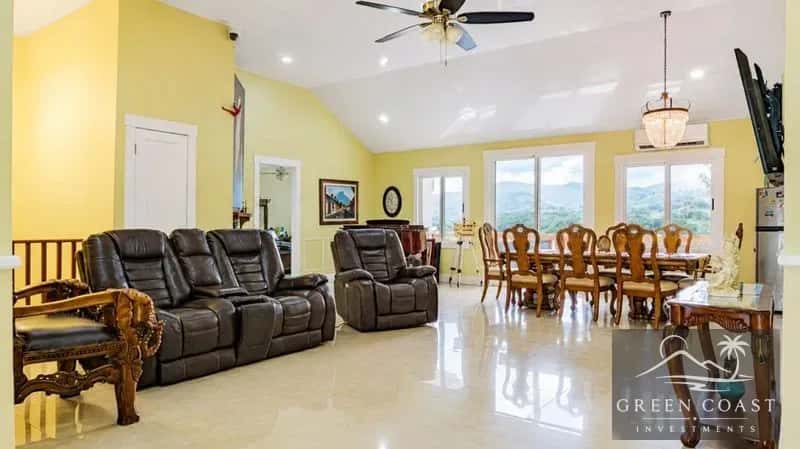
Evaluating active high-end inventory shows how inland luxury assets deliver superior spatial value over coastal builds. For example, this Lakefront Executive Estate on Peninsula | Pool, Chef's Kitchen & Mountain Views | Lake Arenal is listed at $1,300,000—priced $157,000 below the regional luxury market average of $1,457,000.
```
+------------------------------------------------------------------------------------+
| CASE STUDY PROPERTY COMPARISON METRICS |
+-----------------------------+-----------------------+------------------------------+
| FINANCIAL & ASSET METRIC | SUBJECT PROPERTY | REGIONAL LUXURY BENCHMARK |
+-----------------------------+-----------------------+------------------------------+
| Listing Price | USD 1,300,000 | USD 1,457,000 (Average) |
| Price Variance vs Average | -USD 157,000 (-10.7%) | Sector Baseline |
| Micro-Market Category | Luxury Estate / Lake | Guanacaste High-End Sector |
| Active Inventory Comparison | 1 of 3 Active Listings| Range: $1,300,000–$1,674,000 |
| Location Type | Direct Lakefront | Coastal / Inland Mix |
+-----------------------------+-----------------------+------------------------------+
```
Architectural Specifications and Amenities
Designed around its water footprint, this residence combines professional-grade interior buildouts with direct lake frontage:
Chef's Kitchen:* Custom cabinetry, commercial-grade appliances, oversized preparation islands, and integrated dining spaces built for high-capacity hosting.
Custom Infinity Pool:* Positioned on the main terrace elevation to visually merge the outdoor living space with the lake below.
Panoramic Vistas:* Floor-to-ceiling glass systems capture unobstructed views across the Lake Arenal basin and mountain ridgelines.
Covered Terraces:* Stone-paved exterior lounge areas, an outdoor kitchen, and landscaped grounds that lead right down to the water's edge.
Financial Positioning within the Luxury Bracket
| Metric | Property Value | Regional Sector Benchmark |
| :--- | :--- | :--- |
| Listing Price | $1,300,000 | $1,457,000 (Average) |
| Property Type | Luxury Executive Estate | Single-Family Luxury Asset |
| Price Variance | -$157,000 | Sector Baseline |
| Active Comparable Set | 1 of 3 Listings | $1,300,000–$1,674,000 |
Positioned at the entry baseline for regional luxury listings, this property provides high interior build specs and direct lake access at a price point that would buy significantly smaller, older structures in coastal markets like Tamarindo or Papagayo.
---
Step-by-Step Property Acquisition Guide
Buying real estate in Costa Rica as a foreign citizen follows a clear statutory process. Non-resident foreigners enjoy fundamental property protections identical to local nationals, allowing direct fee-simple ownership (Título Supletorio or Dominio Público protections), except for restricted Maritime Zone land on the coast.
```
+------------------------------------------------------------------------------------+
| PROPERTY ACQUISITION FLOW CHART |
+------------------------------------------------------------------------------------+
| [Step 1: Escrow & Compliance] --> Open SUGEF-approved escrow account |
| |
| [Step 2: Title & Survey Audit] --> Perform Folio Real search & map verification |
| |
| [Step 3: Water & Utilities] --> Secure official ASADA / MINAE certificate |
| |
| [Step 4: Closing Execution] --> Sign Protocol Book deed with Public Notary |
| |
| [Step 5: Legal Registration] --> Record title in National Registry (1–3 weeks) |
+------------------------------------------------------------------------------------+
```
Step 1: Execute Intent to Purchase and Establish Escrow
Once an offer is accepted, you sign an Intent to Purchase agreement and deposit earnest money (typically 10% of the purchase price) into a SUGEF-registered escrow account. Foreign buyers must complete Know Your Customer (KYC) documentation to satisfy anti-money laundering regulations before wiring international capital.
Step 2: Title and Survey Verification
Your attorney conducts a full title audit in the Registro Nacional using the property's assigned Folio Real number. This search confirms the title is clean of liens, mortgages, legal claims, and municipal tax debt. At the same time, a licensed topographer checks the physical survey map (plano catastrado) against real-world boundary points.
Step 3: Secure Water and Utility Documentation
Water rights dictate whether a property can secure building permits or municipal connections. You must receive an official carta de agua (water letter) from the local ASADA or verify a registered water concession from MINAE if the estate uses a private well or spring.
Step 4: Deed Execution Before a Public Notary
In Costa Rica, real estate closings require a licensed Public Notary (Notario Público), who acts as a legal officer of the state. The notary drafts the transfer deed (escritura pública) in their official protocol book (protocolo). Both buyer and seller (or their legal representatives holding Power of Attorney) sign the deed upon escrow fund release.
Step 5: Registry Submission and Final Title Recording
The Notary submits the signed transfer deed to the Registro Nacional for final recording. Registration typically takes between one and three weeks. Once entered, you are the official legal titleholder of record in Costa Rica's national database.
---
Tax Framework and Annual Carrying Costs
Managing annual property costs requires a clear understanding of national tax obligations, local municipal levies, and corporate maintenance fees.
```
+------------------------------------------------------------------------------------+
| GUANACASTE PROPERTY TAX & OVERHEAD STRUCTURE |
+----------------------------+-------------------------------------------------------+
| OBLIGATION / FEE TYPE | RATE / CALCULATED BASIS |
+----------------------------+-------------------------------------------------------+
| Municipal Property Tax | 0.25% of registered property value paid annually |
| Luxury Home Tax (Solidarity)| 0.25% to 0.50% (Applies to high-value structures) |
| Real Estate Transfer Tax | 1.5% of declared property transfer value |
| Legal & Notary Closing Fees| 1.0% to 1.5% of purchase price |
| Annual HOA Maintenance | $2,400–$7,200 (Varies by gated community services) |
+----------------------------+-------------------------------------------------------+
```
Municipal Property Tax (Impuesto Territorial)
Costa Rica assesses a flat national property tax rate set at a quarter of one percent paid yearly across all real estate holdings. You pay this directly to the local municipality (such as Tilarán, Liberia, or Santa Cruz) where the asset is located, based on its registered municipal value.
Luxury Home Tax (Impuesto de Solidaridad)
Residential properties with high-end structural finishes fall under the Luxury Home Tax (Impuesto de Solidaridad). This sliding-scale tax ranges from 0.25% to 0.50% annually, calculated on the construction cost of main structures plus underlying land value. Highland acreage properties with reasonable home footprints often sit below this threshold, whereas sprawling coastal builds pay it regularly.
Property Transfer Taxes and Closing Costs
At closing, buyers should budget for transaction and statutory fees:
Real Estate Transfer Tax: Set by law at 1.5%* of the declared purchase price.
National Registry Stamps: Roughly 0.8%* of the transaction value.
Notary Legal Fees: Standardized between 1.0% and 1.5%* of the purchase price.
Total closing costs for real estate acquisitions in Guanacaste generally run 3.5% to 4.0% of the total purchase price.
Corporate Holding Structures vs. Personal Ownership
While you can buy property directly in your personal name, foreign investors often take title through a Costa Rican corporation (Sociedad Anónima or Sociedad de Responsabilidad Limitada). Corporate ownership provides liability protection, simplifies estate planning, and streamlines utility management. Annual compliance costs for active corporations include the corporate tax ($120–$230 USD), resident agent fees, and the annual ultimate beneficial ownership filing (RTBF).
---
Frequently Asked Questions
Can foreign citizens legally own property in Guanacaste?
Yes. Under Article 19 of the Constitution, foreign nationals possess the same fundamental property rights as local citizens. You can hold fee-simple title directly in your personal name or through a local holding corporation without local citizenship or permanent residency.
How much do I need to invest in real estate to qualify for residency?
Under Costa Rica Law 9986, purchasing real estate with a minimum investment value of $150,000 qualifies foreign buyers for the Inversionista (Investor) temporary residency category.
What are average luxury property prices for guanacaste real estate?
Based on Green Coast Investments MLS data for Q1 2026, high-end properties in Guanacaste range from $1,300,000 to $1,674,000, with an average listing price of $1,457,000 across active luxury listings.
What is the driving time from Liberia International Airport to Lake Arenal?
Driving from Daniel Oduber Quirós International Airport (LIR) in Liberia to Lake Arenal peninsula properties takes 90 to 120 minutes along paved state highways (Route 1 and Route 142).
What are the main utility differences between coastal and highland Guanacaste?
Coastal homes face high electric bills due to constant air conditioning and rely on local ASADA water networks or deep wells. Highland properties around Lake Arenal maintain an average temperature of 75°F (24°C), cutting AC power draw by roughly 35% while drawing from spring-fed municipal systems or private wells.
---
Final Market Outlook
Buying guanacaste real estate in 2026 offers a direct path to secure asset growth, legal residency, and an exceptional lifestyle. Whether your goal is capturing short-term vacation rental yield along the coast or securing private, climate-resilient acreage around Lake Arenal, foreign buyers benefit from constitutional ownership protections and strong capital preservation. Evaluating the core fundamentals—water concessions, microclimates, tax obligations, and airport proximity—will keep your real estate transaction secure and successful in northwestern Costa Rica.