
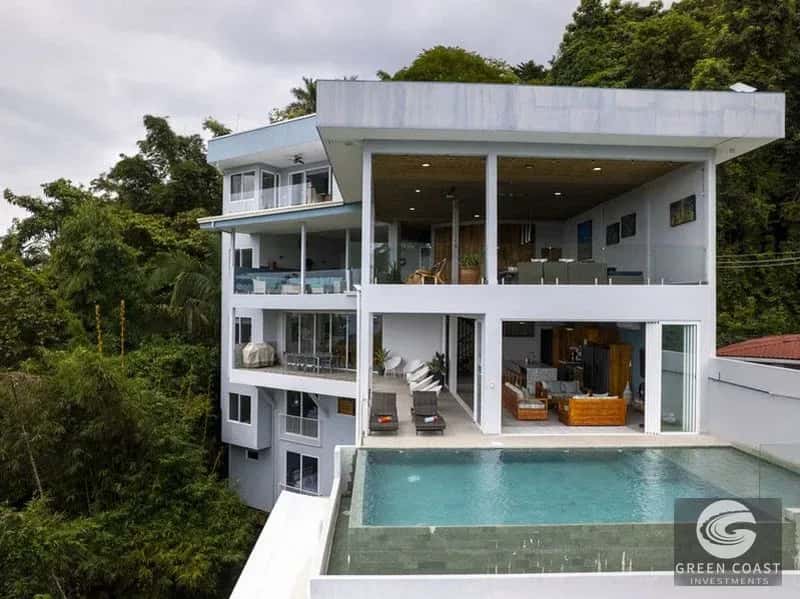
For high-net-worth investors looking to buy property in Manuel Antonio, Costa Rica, a 17-bedroom luxury villa offers a practical opportunity to capture institutional-grade returns through event hospitality and high-capacity group rentals. Positioned in a market with 188 active listings ranging from $48,600 to $12,500,000, this flagship $7,950,000 asset commands top-tier yields by catering to destination weddings and corporate retreats.
Navigating this micro-market requires understanding local zoning laws, water rights, and corporate structuring to protect capital. In our years on this coast, we have seen that securing an established commercial compound provides a scalable operational enterprise backed by fee-simple ocean-view land in Costa Rica's primary eco-tourism corridor.
Buy Property Manuel Antonio Costa Rica: Is a 17-Bed Luxury Villa a Viable Commercial Investment?
High-net-worth US and Canadian buyers seeking to buy property in Manuel Antonio, Costa Rica will find that a 17-bedroom luxury villa functions as an income-generating commercial enterprise rather than a standard vacation home.
The region's geography limits buildable land where primary rainforest meets the Pacific Ocean. This creates a tight supply constraint for large-scale residential compounds. For institutional-grade investors, a property of this scale captures market share by accommodating destination weddings, corporate retreats, and multi-family travel groups that standard boutique hotels simply cannot handle.
Analyzing the $7.95M Anchor Listing
At a purchase price of USD 7,950,000, this featured 17-bedroom estate represents a distinct commercial asset in the Quepos and Manuel Antonio micro-market. You can review the complete financial performance and layout details for the Manuel Antonio 17-Bed Luxury Event Villa with High-Yield Rental Revenue & Ocean Views directly on our platform.
Designed to operate as a high-yield hospitality business, the property pairs panoramic Pacific ocean views with tailored event infrastructure. Rather than relying solely on seasonal leisure rentals, the villa utilizes dual-revenue streams—combining venue fees with high-capacity nightly lodging—to drive top-line metrics far above regional single-family benchmarks.
Local Market Context and Inventory Metrics
Contextualizing this listing within the wider regional market requires looking at current inventory metrics. The market currently holds 188 active listings ranging from USD 48,600 to USD 12,500,000, with an average regional listing price of USD 1,396,335.
With the average listing price sitting at USD 1,396,335 across these listings, the USD 7,950,000 price point places this villa in the upper tier of local inventory. While the baseline market includes smaller residential parcels starting at USD 48,600, ultra-luxury assets command a distinct premium due to sheer scarcity and established commercial performance. Investors evaluating different asset classes can explore active listings across both residential and commercial categories within the Manuel Antonio and Quepos real estate region.
Expert Investor Perspective
In our years on this coast, we have consistently viewed purpose-built luxury assets in the Quepos and Manuel Antonio corridor as strong hedges against broader market volatility.
While inventory under the $1.5 million threshold competes heavily for standard vacation rental bookings, purpose-built event villas above $5 million operate in a space with virtually zero direct competition. For foreign buyers, securing an asset with existing commercial infrastructure eliminates the multi-year permitting and construction timelines typical of Costa Rican commercial developments.
How Do Titled Property Laws and Maritime Concession Zones Impact Manuel Antonio Real Estate?
!Manuel Antonio 17-Bed Luxury Event Villa with High-Yield Rental Revenue & Ocean Views — view 1, Manuel Antonio, Quepos, Costa Rica
Titled property laws and Maritime-Terrestrial Zone (ZMT) regulations dictate where and how you can own, develop, or expand real estate in Manuel Antonio. Under Costa Rica’s Law No. 6043, coastal land is split into two distinct categories: fully titled property (fee-simple ownership) and concession land leased through the local municipality. Understanding this legal framework is critical when evaluating high-value assets across the region's 188 active listings.
Understanding Law No. 6043: Titled Land vs. ZMT Concessions
Costa Rica’s Maritime-Terrestrial Zone Law No. 6043 governs the first 200 meters of land measured from the high-tide line along the entire coastline. The first 50 meters from the high-tide mark are strictly public domain where no private construction, commercial operations, or private ownership are permitted. The remaining 150 meters constitute the restricted zone. Land here cannot be titled; instead, it is leased via a renewable municipal concession, typically granted for 20-year terms. Furthermore, Law No. 6043 restricts foreign ownership in ZMT land, preventing non-residents from holding more than 49% ownership in a company that holds a ZMT lease unless they have resided in Costa Rica for at least five years.
While 95% of beachfront land across Costa Rica falls under ZMT concession rules, Manuel Antonio is geographically unique. The ocean-view ridges and hillsides overlooking Manuel Antonio National Park offer rare, fee-simple titled ownership. A 17-bedroom luxury estate positioned on these elevated ridges provides complete fee-simple property rights, exempting foreign buyers from ZMT foreign-ownership restrictions while preserving long-term capital control.
Municipal Zoning and Legal Due Diligence for Estates
Reviewing the Cantón de Quepos Plan Regulador
Before purchasing a large estate with plans for expansion, multi-structure builds, or commercial event zoning, your legal team must verify the property’s standing under the local Plan Regulador (regulatory zoning plan) maintained by the Municipality of Quepos. This step confirms lot coverage ratios, height restrictions, water availability certificates (uso de suelo), and environmental permits (SETENA) necessary for hosting high-occupancy luxury groups.
Foreign Ownership and Corporate Structuring
US and Canadian buyers can acquire fully titled Manuel Antonio real estate directly in their individual names with equal rights under the Costa Rican constitution. However, asset protection involves purchasing through a domestic entity (Sociedad Anónima or Sociedad de Responsabilidad Limitada). Due diligence requires a clean tax compliance check, verification of the ultimate beneficial ownership registry (RTBF), and a thorough title search at the Registro Nacional to ensure the property is free of undisclosed liens, mortgages, or boundary overlaps.
What Are the Legal Structuring and Tax Obligations for High-Value Costa Rican Assets?
Acquiring a high-value asset in Manuel Antonio requires a distinct corporate framework to mitigate personal liability, optimize tax structures, and handle foreign revenue streams. Foreign investors purchasing luxury real estate—where the average regional listing sits at USD 1,396,335 within a market ranging from USD 48,600 to USD 12,500,000—typically execute transactions through a local legal entity rather than under personal ownership.
Corporate Entity Selection: S.A. vs. S.R.L.
To hold real estate in Costa Rica, foreign buyers generally establish one of two corporate structures. A Sociedad Anónima (S.A.) requires a formal board of directors including a President, Secretary, Treasurer, and a Statutory Auditor, making it ideal for complex joint ventures or multi-partner investments where equity shares dictate voting rights. Alternatively, a Sociedad de Responsabilidad Limitada (S.R.L.) is managed by one or more designated managers without a full board. The S.R.L. is widely favored by US investors due to its pass-through entity tax classification under IRS "check-the-box" rules, simplifying cross-border tax compliance.
Transaction Taxes and Closing Fees
Closing a high-value real estate transaction incurs direct statutory transaction costs. The buyer and seller typically split these fees, though terms remain negotiable:
Property Transfer Tax:* Set at a fixed 1.5% of the registered fiscal value or sale price (whichever is higher).
National Registry and Stamp Fees:* Approximately 0.8% to 1.0% of the declared value.
Legal Notary Fees:* Scaled regulated fees, usually ranging from 1.0% to 1.25% of the purchase price.
Annual Property and Luxury Asset Taxes
High-value residential properties in Manuel Antonio face two primary ongoing municipal and national property tax liabilities:
Municipal Property Tax (Impuesto Territorial):* A standard annual rate of 0.25% assessed on the property's registered value at the local Municipality of Quepos.
Luxury Home Tax (Impuesto Solidario):* Applies to residential structures whose primary construction value exceeds the annual statutory threshold set by the Ministry of Finance. This tax features progressive rates ranging from 0.25% up to 0.55% of the combined value of the land and construction.
Capital Gains and Cross-Border Income Tax
Commercial rental operations generate localized tax obligations regardless of where revenue is deposited. Non-resident property owners generating short-term rental income from US or Canadian guests are subject to Costa Rican corporate income tax on net localized earnings, though expenses, depreciation, and local management fees remain tax-deductible. Regarding capital gains, the standard tax rate is 15%. However, properties owned prior to July 1, 2019, may qualify for a one-time option to pay a reduced 2.25% tax on the total gross sale price instead of the 15% rate on the net gain.
Step-by-Step Acquisition and Operational Blueprint for Event-Focused Villas
!Manuel Antonio 17-Bed Luxury Event Villa with High-Yield Rental Revenue & Ocean Views — view 2, Manuel Antonio, Quepos, Costa Rica
Acquiring and operating a 17-bedroom event villa in Manuel Antonio requires a structured 5-stage real estate transaction followed by a specialized commercial hospitality setup. In a market with 188 active listings ranging from $48,600 to $12,500,000 and an average price of $1,396,335, high-value assets demand rigorous legal compliance and hyper-local vendor integration to maximize net rental yields from destination weddings and corporate retreats.
The 5-Stage Commercial Acquisition Process
Securing high-capacity residential property in the Quepos and Manuel Antonio area involves precise regulatory checkpoints:
1. Letter of Intent (LOI) & Purchase and Sale Agreement (PSA): The buyer submits a formal offer defining price, inspection contingencies, and closing timelines.
2. SUGEF-Compliant Escrow Funding: International capital transfers must clear Costa Rica’s financial regulator, SUGEF (Superintendencia General de Entidades Financieras). Anti-money laundering (AML) verification and source-of-funds documentation typically require 14 to 21 business days for approval. Escrow providers must be registered with SUGEF to hold earnest deposits and closing funds safely.
3. Legal Due Diligence: Corporate attorneys audit the National Registry title, inspect municipal tax standings in Quepos, confirm active building permits, and verify water concessions through the local ASADA or AYA water authority.
4. Closing & Deed Execution: Funds transfer from escrow while the buyer and seller execute the public deed before a Costa Rican notary public.
5. Title Registration: The notary files the deed with the Public Registry, completing official transfer within 10 to 30 days.
Operational Setup for High-Capacity Event Assets
Scaling a 15+ bedroom estate to cater to executive retreats and multi-generational weddings requires commercial-grade infrastructure. Estate managers must install commercial water reserves with high-volume pressure pumps, back-up power generators, and high-density Wi-Fi networks capable of handling 40+ active devices simultaneously without bandwidth drops.
Maintaining high occupancy relies on establishing contracts with the local vendor ecosystem in Quepos and Manuel Antonio. This includes high-capacity private transport operators navigating hillside access roads, full-service catering teams certified in food safety, bilingual private concierges managing eco-adventure logistics, and sound and lighting engineers proficient in securing municipal noise permits from the Quepos local government.
Infrastructure Audits and Preventive Maintenance
Operating a 17-bedroom estate in a tropical coastal environment requires dedicated facilities management. Investors must factor specialized maintenance schedules into their operational budgets to protect structural integrity and operational uptime:
Water Management and Wastewater Systems:* Large compounds require advanced wastewater treatment systems (OSARs) capable of handling peak hydraulic loads during full-occupancy event weekends. In addition, redundant water storage tanks (minimum 10,000-liter capacity) are essential to mitigate seasonal municipal supply fluctuations.
HVAC and Air Purification Systems:* Marine air accelerates corrosion on external condensers. Commercial maintenance plans require quarterly coil treatments, anti-corrosion coatings, and continuous filter changes across all guest suites.
Structural and Roof Deck Inspection:* Given the heavy rainfall during green season months, flat roofs, drainage scuppers, and outdoor structural woodwork must be audited bi-annually to prevent water intrusion and timber degradation.
Mitigating Operational Risk in Eco-Hospitality
Managing large-scale residential assets involves distinct legal and logistical variables compared to standard holiday rentals.
In our work advising buyers on real estate strategy in Costa Rica since 2004, acquiring a 17-bedroom asset in Manuel Antonio isn't merely a real estate transaction; it is the acquisition of an established commercial eco-hospitality enterprise where title security and localized concierge logistics drive your net exit cap rate.
Proper risk mitigation includes maintaining comprehensive liability insurance policies covering commercial event operations, enforcing explicit event rental contracts with mandatory damage deposits, and executing preventive maintenance schedules to safeguard long-term asset value.
How Does Manuel Antonio's Luxury Villa Rental Yield Compare to Tamarindo and Uvita?
When evaluating high-yield Costa Rican real estate, Manuel Antonio delivers strong net operational returns for event-capacity luxury villas compared to Tamarindo and Uvita. Manuel Antonio generates an average luxury yield of 8.5% - 11.2% net operational return, outperforming Tamarindo (6.0% - 7.5%) and the Uvita/Ojochal submarket (5.5% - 7.0%). This margin stems from a tightly constrained geographic footprint where strict topography limits inventory, coupled with demand from Manuel Antonio National Park, which attracts over 500,000 visitors annually according to official SINAC data. Across the local market, buyers navigate 188 active listings ranging from $48,600 to $12,500,000, with an average listing price of $1,396,335.
+------------------+-----------------------+------------------------+
| Regional Market | Net Operational Yield | Primary Yield Driver |
+------------------+-----------------------+------------------------+
| Manuel Antonio | 8.5% - 11.2% | Year-Round / Events |
| Tamarindo | 6.0% - 7.5% | Peak Seasonal Beach |
| Uvita / Ojochal | 5.5% - 7.0% | Eco-Tourism / Privacy |
+------------------+-----------------------+------------------------+
Geographical Constraints and ADR Metrics
Manuel Antonio’s topography—a steep corridor of ocean-view rainforest compressed between the town of Quepos and the national park entry—prevents sprawling development. Unlike Tamarindo in Guanacaste, where expansive coastal plains allow continuous construction of competing properties, or Uvita, where infrastructure is spread across rural terrain, Manuel Antonio’s buildable land is largely exhausted.
This inventory cap directly protects Average Daily Rates (ADR). While a 15+ bedroom estate in Tamarindo relies heavily on seasonal sun-and-surf tourists who vacate during the rainy season, a high-capacity villa in Manuel Antonio captures steady, year-round demand driven by international eco-tourists and destination events.
Micro-Market Yield Breakdown Across Costa Rica's Pacific Coast
To understand why Manuel Antonio consistently leads in net operational yields, investors must analyze the structural performance drivers across competing submarkets:
Manuel Antonio (8.5% - 11.2% Net Yield)
Severe geographic limits restrict new competitive builds, keeping the active listing pool tight across the regional spectrum (188 active listings, $1,396,335 average price). High-volume year-round demand is fueled by international eco-tourism and high-budget event bookings. Furthermore, a dual-income business model combining nightly room rates with event venue fees creates high revenue per square foot to protect yields.
Tamarindo / Gold Coast (6.0% - 7.5% Net Yield)
Flat terrain enables continuous residential development, increasing direct competition among luxury single-family homes. This creates a highly seasonal surf and sun market with occupancy dips during the shoulder and rainy seasons. Higher supply caps ADR expansion, while price competition during off-peak months compresses annual net margins.
Uvita / Ballena Coast (5.5% - 7.0% Net Yield)
Emerging infrastructure and lower land acquisition costs allow growing inventory, though accessibility remains a barrier for large groups. Demand is largely driven by eco-conscious niche travelers and wellness retreats seeking seclusion over high-capacity commercial events. Lower overall density and fewer large commercial event venues limit overall top-line earning capacity compared to Manuel Antonio.
Commercial Event Revenue vs. Standard Holiday Rentals
Large-scale assets configured with 15 or more bedrooms operate under a distinct business model compared to typical 3-to-5-bedroom vacation homes. Large estates command venue fees ($3,000 to $7,000+ per night) for weddings, corporate retreats, and wellness summits, alongside standard guest room rates. Multi-generational families and destination wedding parties book 6 to 12 months in advance, securing high occupancy during traditional shoulder months from May through November. Additionally, fixed overhead costs—such as full-time property management, security, and maintenance crews—are distributed over a higher gross revenue baseline, maximizing the net margin.
While Tamarindo and Jacó attract tourist volume, their rental inventory relies predominantly on standard leisure travel, creating wider yield fluctuations. Manuel Antonio’s ability to combine eco-tourism traffic with specialized high-occupancy event hosting makes large-scale properties a resilient asset class within Costa Rica's real estate market.